
How to Use Poker Chips
Table of Contents
ToggleHow to use poker chips
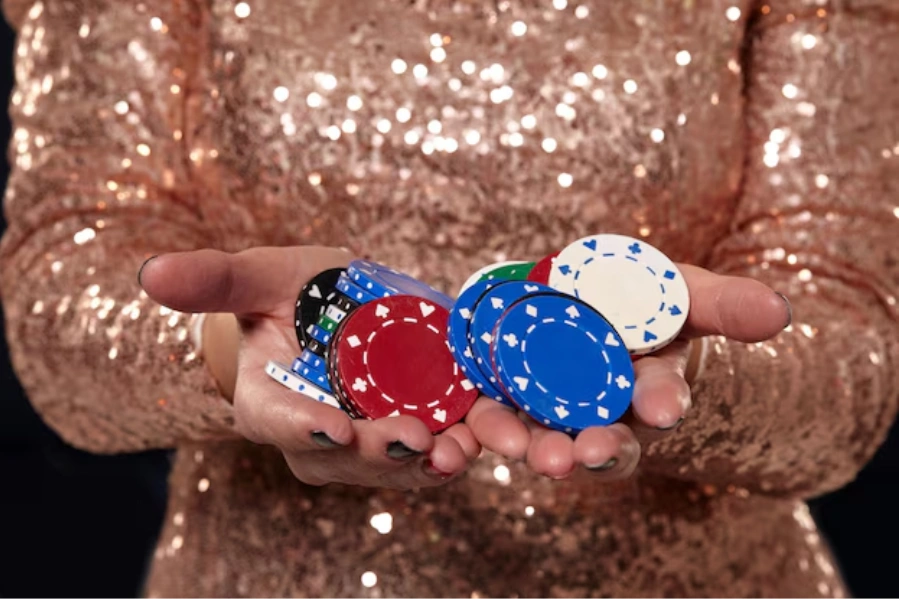
There are more meanings attached to poker chips than just the vibrant colors and intricate designs that you see. Poker chips are what make poker games meaningful in the sense that they simplify betting by standing in place of cash during betting rounds, track wagers, and create a memorable casino experience.
Here’s the thing: many beginners often get stuck in the science behind poker chips. Most of them could not wrap their head around how different color chips work, how much each poker chips worth in commensuration to the intended monetary value, and the like.
You are not alone, confusion can spring up with the chips setup and distribution. In this guide, we give you an in-depth explanation of how to use poker chips, how you can understand standard denomination and even master what each poker chip represents.
Step-by-Step Guide: How to Set Up Poker Chips
Poker chips are just pieces of items without adequate knowledge of how to use them. Adequate understanding of how to set up poker chips ensures your games run smoothly and efficiently. The following is the step-by-step process on how to set up Poker chips.
Step 1: Choose the type of game you are playing
There are different types of games, including cash games and tournaments. In a cash game, each poker chip represent real money that every player can buy in and cash out at any time. While a tournament game allows every player to start with the same number or chip, that number can only be increased over time until one winner remains.
Step 2: Make an estimate of the total number of chips needed
There’s a general rule of thumb for this, which states that:
- 2–6 players: 300 chips total
- 7–10 players: 500 chips total
- Large games or tournaments: 800–1,000 chips
Step 3: Assign chip denominations
If you are playing home games, chips value are quite flexible to the point that you can decide the amount of value that each chip color represents. But in a conventional game, the standard value for each poker chip can range from.
- Lowest value chip = 1 unit
- Next level = 5 units
- Next level = 25 units
- Higher chips = 100 or 500 units
Step 4: Ensure each player begins with an equal starting stack
This part can not be overestimated, especially when you are playing a tournament. You can start a beginner tournament with a total of 100 chips and ensure to share them as follows.
- 40 low-value chips
- 40 mid-value chips
- 20 high-value chips
While for cash games, starting stacks depend on the agreed buy-in. For example, if the buy-in is $50, you distribute chips that total $50 in value.
Step 5: Set Blinds or Betting Limits
This is important to keep the game going. Blind or betting limits are set of rules that ensure every player has a fair playing ground and make the game competitive. For instance, if you are playing a tournament, you can establish a blind level and decide how often they increase, ranging between 15 to 20 minutes or more based on your preference. While in a cash game, there are fixed blinds that can be around $0.25/$0.50 or $1/$2.
How many poker chips do you start with?

The number of poker chips you start with is decided by the type of game and how long you want the game to last. The following table gives you the number of poker chips you can start with for each type of poker game.
Game Type | Typical Starting Value | Recommended Chips Per Player | Example Distribution | Best For |
Cash Game | Based on buy-in ($20, $50, $100, etc.) | 50–100 chips | 40% low value 40% mid value 20% high value | Flexible home games |
Beginner Tournament | 1,000 – 1,500 chips | 50–100 chips | 40% small denom 40% mid denom 20% large denom | Shorter tournaments |
Standard Tournament | 3,000 – 5,000 chips | 75–100+ chips | More low denominations for blind levels | Longer, structured play |
Deep Stack Tournament | 10,000+ chips | 100+ chips | Heavy on small & mid chips early | Competitive/extended games |
Standard Denominations: How Much Are Poker Chips Worth?
One of the most common question that most people ask is how much poker chips are worth. There is no straight-line answer to this question because the value for poker chips is mostly determined by the game house. For example, in a casino, poker chip values are extremely regulated and constant in the sense that everyone at the table understands what each poker chips represent. The reverse is the case in a home game, where each player comes together to determine the poker chip value before starting the game.
Setting | Typical Chip Values | Do Chips Represent Real Money? | Value Flexibility | Notes |
Home Cash Game | 1, 5, 25, 100, 500 (or chosen system) | Yes | Flexible (set before the game starts) | Players agree on chip values before play |
Casino Game | $1, $5, $25, $100, $500, $1,000+ | Yes | Fixed | Values are printed and regulated |
Tournament (Home or Casino) | 1,000 – 10,000+ starting units | No (represents tournament units) | Structured | Chips determine survival, not direct cash value |
Note: in home game, if your base unit is $1, then the chips represent $1, $25, and $100. While in low-stakes games, you can see your base value starting from $0.25.
What color are poker chips?
Poker chip comes in different colors like white, red, and others. Each pokerchip’ss color represents a value that is mostly agreed upon in a home game, while they are standardized in a casino. Understanding what each poker chip color represent ensure you are free from confusion that might arise during games. The following are the traditional poker chips’ colors and their values.
- White – Lowest value (often $1)
- Red – $5
- Green – $25
- Black – $100
- Purple – $500
- Orange or Yellow – $1,000 (in higher-stakes games)
How to shuffle poker chips?
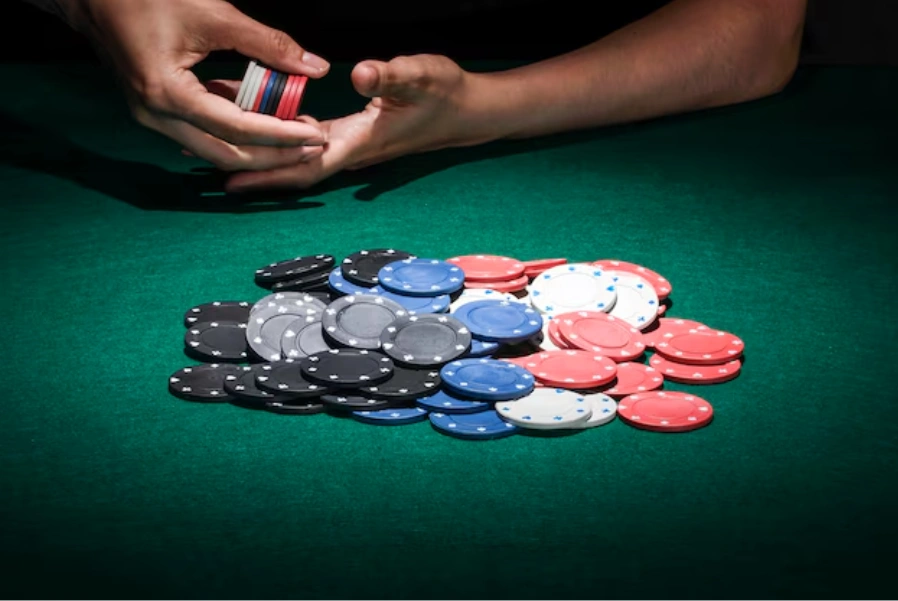
Shuffling poker chips is a classic table skill that is often associated with experienced players. While these skills have no bearing on game play, understanding how to shuffle poker chips is a great skill that enhance comfidence and shows that you are not a newbie. The following steps show how to shuffle poker chips.
1. Start small
Take 6 to 8 out of the stack of chips that are of the same size. Don’t start shuffling too many chips at once.
2. Split the stack
Divide the poker chip into two equal mini stacks.
3. Position your fingers.
Place your thumbs on the inside edges of both stacks. Use your index and middle fingers to stabilize the outside edges.
4. Push Inward Gently
Apply light pressure with your thumbs so the chips begin to interlace.
5. Let Them Snap Together.
As they mesh, allow them to fall into a single stack smoothly.
Where to buy poker chips?
If you are serious about hosting a poker night, that feels excellent sandorganized, premium, designed, customized poker chips are your best bet to elevate your games. This is where Fastprintstar comes in with our exquisitely designed poker chips that reflect your brand, events, and personal style. We offer you durable clay and composite chips with professional weight portion and high resolution custom printing. And when you are eager to purchase your custom poker chips, ensure you find your way to Fastprintstar.
Final Thought
It’s undeniable that understanding how to use a poker chip properly completely transforms your poker experience. From setting up the rigjr denomination to understanding the chip’s color, a concise knowledge about poker chip usage is a timeless one that helps create a smoother and more professional game. Also remember thatwhetherr you are hosting a home game or a branded poker event, customized poker chips will always come in handy to give a lasting impression.